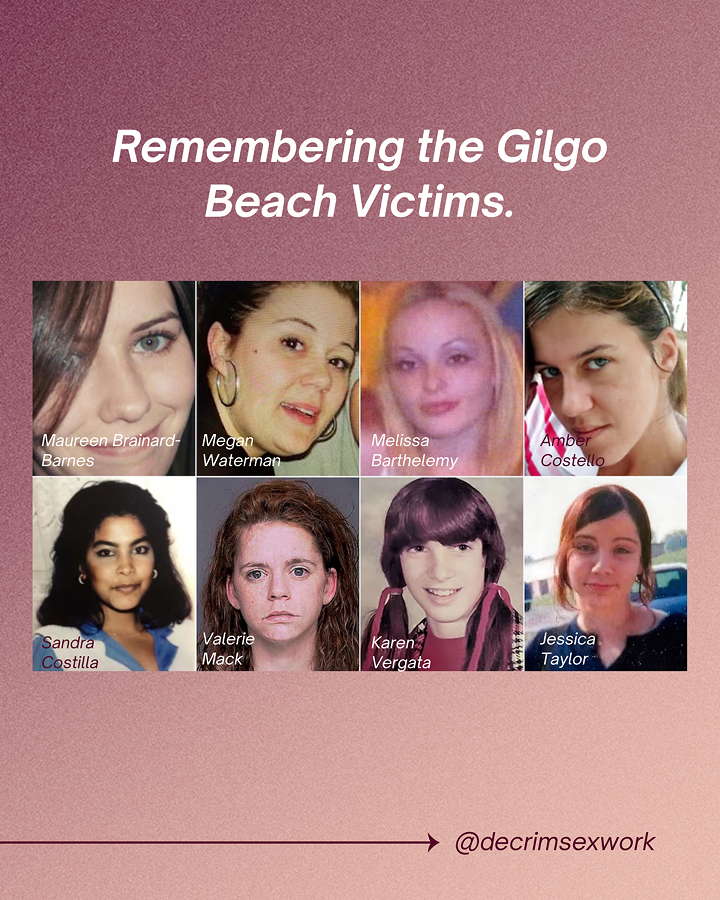
The guilty plea from Rex Heuermann in the Gilgo Beach murders marks a major turning point in a case that remained unsolved for more than a decade.
A series of killings was uncovered beginning in 2010, when human remains were discovered along Ocean Parkway on Long Island. Over time, multiple victims were identified and many of them were women who had been engaged in sex work and using online platforms to connect with clients. The case drew national attention not only because of the number of victims, but because it remained unsolved for years, with repeated investigative missteps and long stretches without answers.
As details of the investigation and news media about the case continue to emerge, it has become clear that other sex workers were aware of the suspect’s violent tendencies. Unfortunately, these important tips could never be relayed to investigators, who would have arrested those individuals for prostitution. The first bodies were found in 2010, and it took 13 years to identify the suspect — years where he continued patronizing and likely perpetrating violence against sex workers. If New York had a safe reporting policy in place at that time, it is likely that this serial killer would have been discovered much sooner.
The criminalization of consensual adult sex work is the throughline that made the victims vulnerable, impacted the investigation, and left a serial killer on the loose. When people involved in the sex trade — whether by choice, circumstance, or coercion — are victims of violent crime and exploitation, it is difficult for them to come forward due to fear of arrest. When abusers are not discovered by law enforcement, they are able to continue their acts of violence and exploitation with impunity.
The case also reflects the impact of stigma. When victims are perceived as less credible or less worthy of protection, investigations can lose urgency. In the years when the Gilgo Beach case stalled, advocates repeatedly pointed to the way bias against sex workers can influence how cases are prioritized, resourced, and pursued.
Since then, there have been incremental policy shifts in New York, including laws designed to make it safer for people to report violence without facing prosecution for low-level offenses. These changes acknowledge a core problem: public safety depends on people being able to come forward without fear.
At the same time, the case underscores the limits of partial fixes. As long as consensual adult sex work remains criminalized, barriers to reporting persist. The conditions that kept critical information out of reach in the early stages of the Gilgo Beach investigation are not unique to this case.
Heuermann’s plea brings long-awaited accountability, but it also serves as a reminder of how much earlier intervention might have been possible under different legal and social conditions. For many advocates, that is the piece that cannot be overlooked as the case finally comes to a close.
Decriminalize Sex Work (DSW) was instrumental in the passage of safe reporting laws in New York, Rhode Island, and Vermont.